


Best Humidification Systems for Small Collections
Table of Contents
- Why Small Collections Need Precise Humidity Control
- Active vs Passive Cigar Humidification: Which Fits Your Setup
- Sizing and Capacity: Matching Systems to Cubic Feet
- How to Calibrate a Digital Hygrometer for Accuracy
- Cigar Humidor Maintenance Tips for Long-Term Storage
- Smart Home Integration and Cross-Collection Compatibility
- Conclusion
- Frequently Asked Questions
Last Updated: October 2, 2026
Why Small Collections Need Precise Humidity Control
Cigars are hygroscopic, meaning they absorb and release moisture from the surrounding air until they reach equilibrium. For a small collection, that balance is fragile. A handful of cigars in a desktop humidor can swing from ideal to ruined far faster than a packed cabinet, because there is less tobacco mass to buffer changes in ambient conditions.
Active vs Passive Cigar Humidification: Which Fits Your Setup
The choice between active and passive cigar humidification comes down to how much control you want versus how much attention you are willing to give. Passive systems release moisture gradually and rely on you to monitor conditions. Active systems measure humidity and add moisture automatically, holding a set-point with far less babysitting.
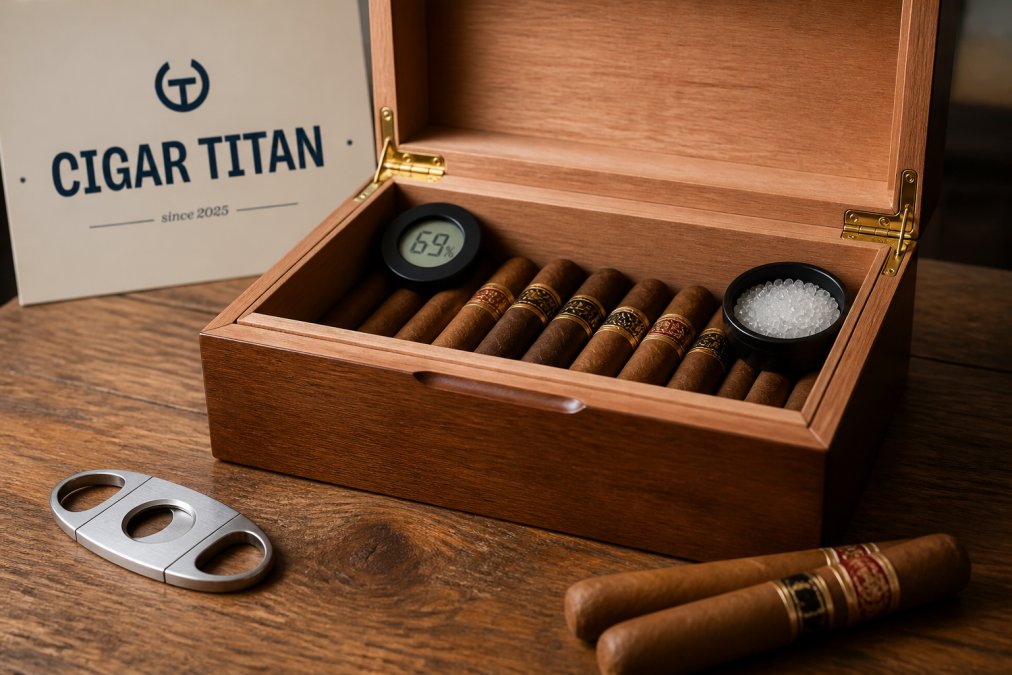
Passive Systems: Beads, Gels, and Foam
Passive humidifiers are the traditional route. Desiccant beads are the most respected option: they absorb excess moisture when humidity climbs and release it when conditions dry out, which gives you two-way moisture regulation from a single container. Gels and florist foam hold water and release it slowly, but they tend to over-humidify in humid climates because they only add moisture, never remove it.
Active Systems: Electronic and Ultrasonic
Active humidifiers use a sensor and a controller to maintain a target. Electronic humidification units typically use one of three methods: evaporative wicks that blow air across a moistened surface, ultrasonic plates that vibrate water into a fine mist, or electrode steam units that boil water into vapor. Evaporative and ultrasonic designs suit small collections well because they add moisture gently.
Sizing and Capacity: Matching Systems to Cubic Feet
Match your humidifier to the interior volume of your humidor, measured in cubic feet, not to the number of cigars alone. Multiply interior length by width by height in inches, then divide by 1,728 to get cubic feet. A typical 50-cigar desktop humidor runs roughly one to two cubic feet.
| Humidor Size | Interior Volume | Recommended System | Refill Cadence |
|---|---|---|---|
| 25-50 cigars | 1-2 cubic feet | Bead container, passive | Every 3-6 weeks |
| 75-150 cigars | 2-4 cubic feet | Beads or evaporative active | Every 2-4 weeks |
| 150-300 cigars | 4-8 cubic feet | Electronic active | Every 1-3 weeks |
How to Calibrate a Digital Hygrometer for Accuracy
Knowing how to calibrate a digital hygrometer is the single most useful skill in cigar storage, because an inaccurate sensor makes every other decision unreliable. Most consumer hygrometers ship with a stated accuracy of plus or minus two to five percent, and some drift further over time.
Salt Test Method
The salt test creates a known reference of 75% relative humidity. Here is the full procedure:
- Fill a bottle cap with table salt and add a few drops of distilled water until it forms a thick paste, not a puddle.
- Place the cap and your hygrometer inside a sealed zip-top bag or airtight container.
- Keep the container at a stable room temperature for 8 to 12 hours.
- Read the hygrometer without opening the container.
Adjusting and Rechecking
Many digital units have a calibration offset you can set directly. If yours does not, write the offset on a label and apply it mentally every time you read the display. Recheck calibration every six months, and after any battery change. A sensor that was accurate in spring can drift by fall.
Cigar Humidor Maintenance Tips for Long-Term Storage
Reliable maintenance comes down to a rhythm: refill on schedule, keep air moving, and know what to do when readings drift. Skip any of the three and even a well-chosen system will let you down.
Refill Intervals and Water Quality
Refill passive systems when humidity drops two to three points below your target, not when they look dry. Beads can look unchanged while their capacity is spent. Distilled water is the only safe choice. Tap water introduces minerals that clog beads and feed mold, and the damage is cumulative, once beads are fouled, they regulate poorly and cannot be restored.
| System Type | Check Cadence | Refill Signal |
|---|---|---|
| Passive beads | Weekly visual, biweekly reading | Humidity 2-3 points below target |
| Evaporative active | Weekly reservoir check | Wick stiff or discolored |
| Ultrasonic active | Weekly reservoir check | Mist weakens or white dust appears |
Airflow and Placement
Air circulation prevents micro-climate pockets where one corner of the humidor sits at 75% while another sits at 62%. Leave a little space between cigars rather than packing them tight, and rotate the front row to the back every few weeks if you do not smoke evenly. Keep the humidor out of direct sunlight and away from exterior walls, heating vents, and windows, since all three create temperature swings that your humidifier then has to fight.
Troubleshooting Common Humidity Fluctuations
When readings drift, diagnose before you adjust. Adding water to a system that is already over-humidifying makes mold more likely, not less.
- Humidity climbs above target and stays there. In humid climates, gel and foam systems only add moisture and cannot pull it back down. Switch to two-way beads or add a small amount of fresh desiccant. Check that the humidor seal is not trapping moisture after a refill.
- Humidity drops fast after a refill. The bead pack is likely spent or the humidor seal is leaking. Test the seal by closing the lid on a dollar bill, if it slides out easily, the seal needs attention. A dry cedar interior also absorbs moisture on first fill; season new humidors before trusting a reading.
- Readings swing widely day to night. This is usually temperature, not the humidifier. Move the humidor away from windows and exterior walls, and check whether the hygrometer is sitting in direct airflow from a vent.
- Mold appears on cigars or cedar. Mold needs sustained humidity above roughly 72% and stagnant air. Remove affected cigars, wipe cedar with distilled water and let it dry fully, and increase spacing. Do not try to smoke moldy cigars.
- Hygrometer reads steady but cigars feel wrong. Recalibrate with the salt test. A sensor that drifted three points low will have you storing cigars drier than you think.
Smart Home Integration and Cross-Collection Compatibility
Most guides treat humidification as a set-and-forget chore. For a small collection, the real risk is not the device, it is the week you forget to check it. Smart monitoring closes that gap, and cross-collection planning keeps you from buying twice.
Remote Monitoring for Small Collections
A Wi-Fi hygrometer costs less than a mid-range passive humidifier and solves the biggest weakness of a desktop setup: you cannot see a problem until you open the lid. Look for a sensor that logs relative humidity over time, not just a live readout. Trends matter more than snapshots. A slow two-point drop over ten days tells you a bead pack is fading; a sudden spike tells you someone left the lid ajar.
Cross-Collection Compatibility: Cigars, Pipe Tobacco, and Accessories
If you store cigars alongside pipe tobacco or accessories, do not assume one humidification set-point fits all. Cigars generally sit in the 65% to 70% range. Pipe tobacco is more forgiving but behaves differently depending on cut and casing, aromatics and Virginia flakes can tolerate slightly drier conditions, while some blends prefer a touch more moisture. Forcing both into one container means one of them is always slightly off.
Environmental Impact and Energy Draw
Passive bead systems use no electricity and need only occasional distilled water, which makes them the lower-impact choice for a small collection. Active evaporative and ultrasonic units draw continuous power, and ultrasonic designs consume more water because they atomize rather than wick. If you want to reduce impact further, use distilled water from a refillable source rather than single-use plastic jugs, and replace bead media only when it stops holding a set-point, not on a fixed calendar.
Conclusion
The hard part of small-collection storage is not picking a device. It is staying consistent when life gets busy and the humidor sits untouched for a month. Cigar Titan stocks a curated range of premium cigars and accessories, with proper humidity control built into how we store and ship every order, plus secure packaging that protects your cigars in transit.
Frequently Asked Questions
What is the ideal relative humidity for storing premium cigars in a small collection?
The ideal relative humidity for premium cigars is between 65% and 70%. This range keeps the tobacco oils intact, prevents mold, and ensures a smooth draw. For small collections, fluctuations happen faster, so use a calibrated digital hygrometer and check it daily. If you live in a dry climate, you may need an active humidification system to maintain this set-point consistently.
Do small cigar collections require active or passive humidification?
It depends on your climate and collection size. Passive systems like desiccant beads work well for collections under 50 cigars in stable indoor conditions. Active systems, such as electronic humidifiers, are better if you live in a dry area or have a larger small collection (50-200 cigars). Active units automatically regulate moisture, reducing maintenance and preventing fluctuations that can damage cigars.
How often should I recharge my cigar humidification system?
Recharge frequency depends on the system type and ambient conditions. Passive beads typically need recharging every 2-4 weeks, while electronic humidifiers may only need a refill every 1-2 months. Check your hygrometer daily; if humidity drops below 65%, it's time to recharge. In dry climates, expect more frequent refills. Always use distilled water to prevent mineral buildup and mold.
How do I choose between beads, gels, and electronic humidifiers for my collection?
For small collections, beads are affordable and low-maintenance, gels release moisture slowly but require more monitoring, and electronic humidifiers offer precise control with minimal effort. If you want set-and-forget convenience and your collection is worth more than a few hundred dollars, an electronic system is the best choice. For budget-friendly simplicity, beads work well as long as you calibrate your hygrometer and check regularly.


