


How to Identify Rare Pipe Tobacco: 2026 Collector's Guide
Table of Contents
- How to Identify Rare Pipe Tobacco: The Identification Framework
- The Three-Layer Method: Label, Tin, Tobacco
- Decoding Tobacco Tin Date Codes and Manufacturer Marks
- Counterfeit Detection: Chemical and Sensory Testing at Home
- A Standardized Grading Scale for Rare Pipe Tobacco
- Pipe Tobacco Aging Guide: What Time Does to a Blend
- How to Store Pipe Tobacco Long Term Without Losing Value
- Conclusion: Building a Rare Tobacco Collection That Holds Up
- Frequently Asked Questions
Last Updated: October 4, 2026
How to Identify Rare Pipe Tobacco: The Identification Framework
Knowing how to identify rare pipe tobacco starts with one habit: read the container before you read the leaf. Collectors routinely overpay for ordinary tins because nobody checked the stamp on the bottom.
Three layers decide almost every case. The label tells you what the maker claimed. The tin tells you when it was packed. The tobacco itself tells you whether either claim survives contact with your nose and fingers.
That last layer is where most guides stop short.
The Three-Layer Method: Label, Tin, Tobacco
Work in order: label, then tin, then leaf.
Layer one, the label. Check print quality, paper stock, and whether the design matches the claimed era.
Layer two, the tin. Look for the manufacturer's stamp, seam style, and lid fit.
Layer three, the tobacco. Only now do you assess the leaf, and only after the first two layers have earned your attention.
If any layer contradicts the other two, walk away. Collectors who buy on a single strong signal tend to overpay.
Decoding Tobacco Tin Date Codes and Manufacturer Marks
Tobacco tin date codes are the fastest route to a tin's real age, and they follow patterns you can learn in an afternoon. Most American and European makers stamped or printed a short alphanumeric string on the bottom or side seam.
Reading Stamped, Printed, and Handwritten Codes
Stamped codes are the most reliable. They were pressed into the metal at packing, so they age with the tin and can't be added later without tool marks.
Printed codes came later and fade differently than the surrounding label. If the code looks sharper than the artwork, treat it as suspect.
Handwritten codes appear on small-batch and shop-labeled tins. They carry real information but are the easiest to fake, so weigh them accordingly.
A practical starting point: photograph the code, note the tin's country of origin, then cross-reference against collector archives and manufacturer documentation. The FDA tobacco product guidance is useful for understanding how modern products are labeled, which helps you spot anachronisms on older tins.
Counterfeit Detection: Chemical and Sensory Testing at Home
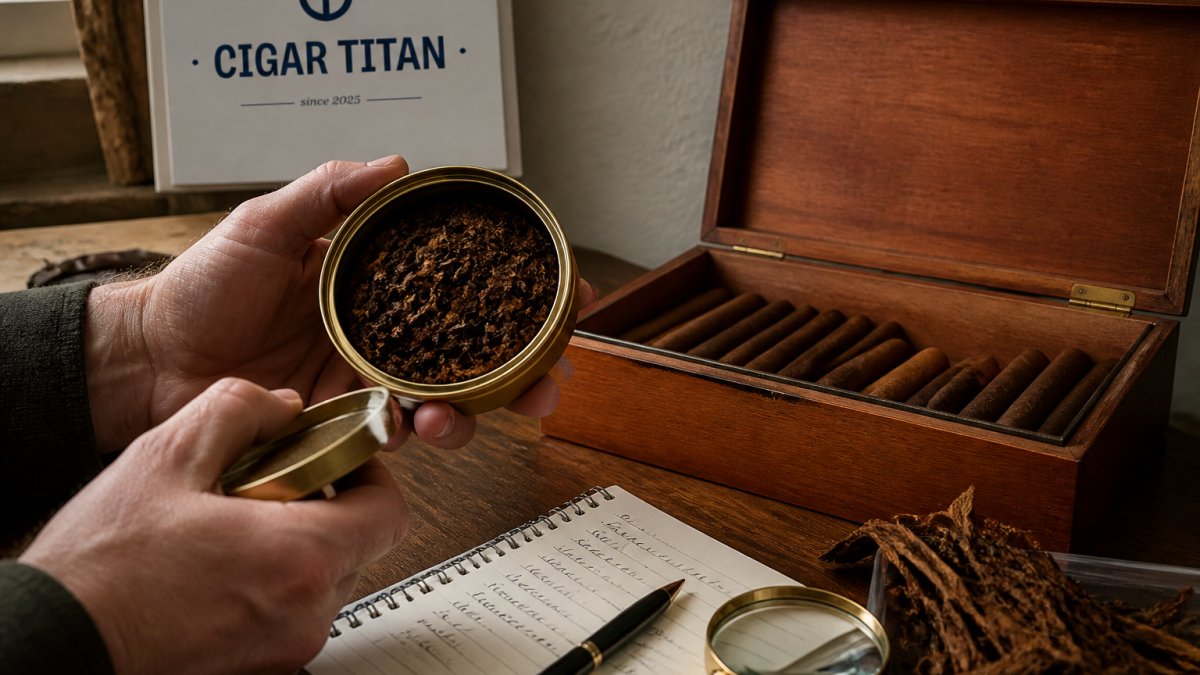
Counterfeits cluster around two things: scarce blends and intact packaging. The tin looks right, the label is close, and the contents are ordinary ribbon cut from a bulk supplier. The same pattern shows up in the cigar world.
The Nose, the Rub, and the Burn Test
Start with the nose. Genuine aged tobacco smells integrated, with casing, leaf, and years blended into one aroma.
Next, the rub. Work a small pinch between your fingers: real aged ribbon cut holds together slightly before separating, while leaf that crumbles to dust has been stored badly regardless of the label.
Finally, the burn test. Smoke a small bowl slowly and note the ash: hard, dark ash suggests heavy casing or added humectants, while light, loose ash suggests clean leaf.
Spotting Fake Bands, Stamps, and Box Codes
Counterfeiters rarely get every detail right.
Box codes follow the same logic. Genuine boxes carry a factory code, a date stamp, and a health warning matching the era of production. A box code referencing a factory that didn't exist that year, or a warning label in the wrong language for the market, is a red flag. The same anachronism test applies to tins: a date code predating the brand's known packaging change is almost always a reprint.
A Simple Verification Workflow
Work through four checks in order before you buy anything scarce:
- Compare the code to the era. Cross-reference the stamp against collector archives and manufacturer documentation. The FDA tobacco product guidance is useful for understanding how modern products are labeled, which helps you spot anachronisms on older tins and boxes.
- Inspect the seal or cellophane. A genuine factory seal holds tension. A resealed tin often rattles.
- Weigh the contents. Counterfeit tins and boxes are frequently lighter or heavier than the genuine article because the filler density differs. A kitchen scale and a known-good reference will catch most of these.
- Smell and feel before you pay. If the aroma is flat or the leaf feels wrong, no amount of correct packaging saves the purchase.
A Standardized Grading Scale for Rare Pipe Tobacco
Most sellers grade by feel. We prefer a fixed scale, because it makes two tins comparable even from different sellers.
The Five-Point Condition Grading Scale
Score each item on five criteria, one point each, for a maximum of five. Anything scoring four or five is a hold. Anything scoring three is a smoke. Anything scoring two or below is parts or pass.
| Criterion | What to Check | Point Awarded When |
|---|---|---|
| Seal integrity | Lid tension, cellophane, box wrap | Seal is factory-original and undisturbed |
| Label or band condition | Print sharpness, color registration, embossing | No fading, blurring, or reprint tells |
| Code legibility | Date stamp, factory code, warning label era | Code is legible and matches the claimed year |
| Contents condition | Leaf moisture, ash behavior, filler consistency | Leaf is sound, aroma is integrated, ash is clean |
| Structural integrity | Tin seams, box corners, wrapper cracks | No rust bleed, dents, or wrapper damage |
Applying the Score
| Score | Grade | Tin or Box Condition | Tobacco or Cigar Condition | Collector Notes |
|---|---|---|---|---|
| 5 | A | Sealed, sharp label, legible code | Original, no rust bleed, firm ash | Top-tier, buy with confidence |
| 4 | B | Sealed, minor label wear | Sound, slight drying at edges | Strong value, most common find |
| 3 | C | Opened, resealed cleanly | Rehydrated, aroma intact | Smoke it, don't hold it |
| 2 | D | Opened, dented or rusted | Dry, faded, or crumbled | Parts value only |
| 1 | F | Compromised seal, heavy damage | Mold, beetles, or total desiccation | Walk away |
Tie-Breakers and Edge Cases
Two items can score the same and still differ in value.
A few edge cases come up often enough to name. A tin with rust bloom on the seam but a sound interior scores a four, not a three, because the rust hasn't reached the leaf.
Apply the scale before you discuss price. Sellers respond better to a graded offer than a vague one, and you'll avoid the awkward negotiation that follows a surprise.
Pipe Tobacco Aging Guide: What Time Does to a Blend
Aging changes a blend in predictable ways once you know the base leaf.
The variables that matter most are temperature, humidity, and light. A steady, dark, moderate environment does more than any single storage gadget.
Not everything improves. Aromatics topped with delicate flavorings often fade rather than develop, so a long rest can cost you the quality you bought the tin for.
How to Store Pipe Tobacco Long Term Without Losing Value
Storage decisions determine whether a tin appreciates or quietly degrades. The goal is a stable environment with minimal handling.
- Keep sealed tins sealed until you intend to smoke them
- Store opened tobacco in airtight glass, away from light
- Maintain steady humidity rather than chasing a perfect number
- Keep a written log of acquisition dates and conditions
For long-term holds, group tins by grade and check them twice a year. A quick inspection catches rust bloom before it reaches the leaf.
At Cigar Titan, humidity control is central to how we handle inventory, which is why collectors trust us with tins they intend to hold for years. Our Smithsonian guidance on preserving collections style of careful, documented storage applies to tobacco just as it does to any aging material.
Conclusion: Building a Rare Tobacco Collection That Holds Up
The collectors who do well over a decade grade honestly and store patiently. They buy the tin in front of them, not the story attached to it.
If you want a starting point with proper humidity control and secure packaging, browse our curated selection and our signature pipe tobacco blend.
Shop Now
Answers to common questions about identifying and storing rare pipe tobacco.
How do I tell if a tobacco tin is genuinely sealed?
A genuine factory seal holds tension when you twist the lid. If the lid spins freely or the tin rattles when shaken, it has likely been opened and resealed. Check the rim for distortion and compare the date code's sharpness against the surrounding label print.
What does aged pipe tobacco smell like?
Properly aged tobacco smells integrated, with the casing, leaf, and time blended into a single aroma. Flat or sharply sweet notes usually indicate a topping applied over the leaf rather than absorbed into it, which is common in counterfeits.
Can I store pipe tobacco in the original tin long term?
Sealed tins store well in a dark, stable, moderate environment. Once opened, transfer the tobacco to airtight glass and keep it out of light. Temperature swings stress seals more than steady warmth does.
Does all pipe tobacco improve with age?
No. Virginia-forward blends generally sweeten and deepen, while Latakia-heavy blends soften over time. Aromatics topped with delicate flavorings often fade, so long storage can reduce what made the blend distinctive.
Frequently Asked Questions
What makes a pipe tobacco blend considered rare or collectible?
A blend earns rare status through discontinued production, limited annual releases, or long aging that changes the leaf's character. Collectors look for sealed tins with intact tax stamps, clear maker marks, and documented provenance. Blends from closed manufacturers carry extra weight because no more will ever be produced. Condition matters as much as the name on the label: a dented tin with a compromised seal loses most of its value even if the blend inside is legendary.
How can I determine the age and authenticity of a sealed tobacco tin?
Start with the tobacco tin date codes stamped or printed on the bottom or side. Many manufacturers use a letter-number sequence where the letter indicates the month and the number the year. Cross-check the code against the label design, tax stamp, and tin material, since packaging changed at known points in history. A tin claiming 1970s origin but showing a modern barcode or plastic seal is almost certainly a fake or a re-pack.
Can I smoke 10-year-old pipe tobacco, and does it improve with age?
Yes, you can smoke 10-year-old pipe tobacco if the tin stayed sealed and the contents never dried out. Virginia and Balkan blends often improve with age as the sugars ferment and the smoke rounds out. Aromatics tend to fade because their toppings evaporate over time. Open the tin, check for mold or a sour smell, and let the tobacco breathe for 20 minutes before packing a bowl.
How should rare pipe tobacco be stored to maintain its value?
Keep sealed tins in a cool, dark place with stable humidity, ideally between 65 and 70 percent. Do not open a sealed tin you plan to resell, since breaking the seal drops the value immediately. For opened tobacco, use glass jars with airtight lids and store them away from sunlight. Avoid plastic bags for long-term storage because they let aroma escape and can transfer flavor over months.
Are there specific manufacturers known for producing rare pipe tobacco?
Several houses built reputations on limited-production blends that now trade among collectors. Names tied to small-batch Virginia flakes, Balkan mixtures, and aged navy cuts come up most often in collector circles. When a manufacturer closes or discontinues a line, existing tins gain scarcity value overnight. Provenance matters: a tin with a documented purchase history from a reputable shop carries more weight than one found at a flea market.
What are the signs of a high-quality, well-aged pipe tobacco blend?
Look for a uniform ribbon cut or flake with no excessive dust, a deep color that shifts from bright gold to dark mahogany with age, and a tin note that smells rich rather than sharp or chemical. The leaf should feel pliable, not brittle. When you rub a pinch between your fingers, it should separate cleanly. A well-aged blend burns cool and even, with no harsh bite on the tongue.


